
More dice = more fun

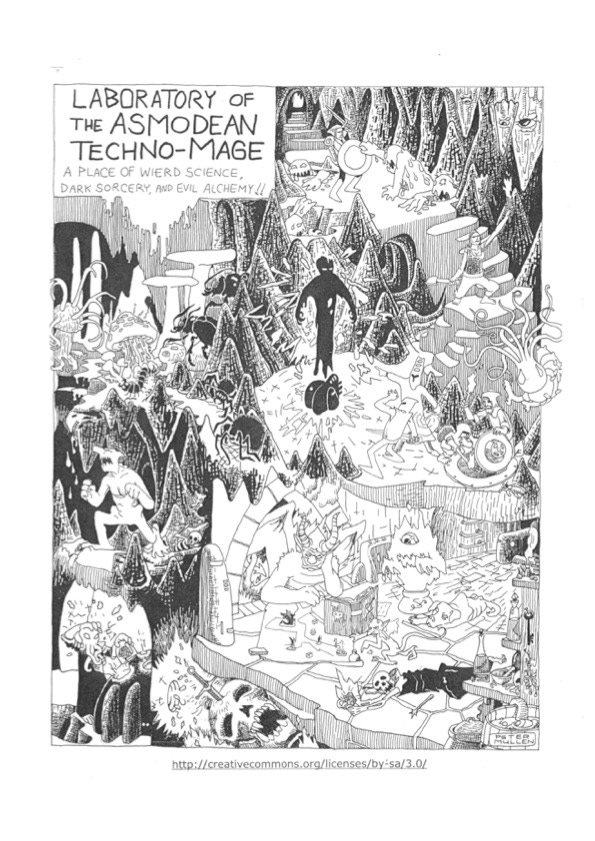
Laboratory of the Asmodean Techno-Mage, by Peter Mullen. One of the winners of the One Page Dungeon Contest 2010. 16 years old, and still so, so good.
I played it with my kids. First, we used the XD20 rules (d20+stat against difficulty). My girls were OK with the rules, but I noticed the spark was missing.
I switched over to my Risus variant, and the game started to sing. There is something magical about dice pools: The better you are, the more dice you roll. This is immediate feedback, tangible, in your hand. My girls loved it.
Joesky Tax: my Darkworm Colt Risus rules.
DARKWORM COLT RISUS rules are based on Risus: The Anything RPG by S. John Ross, published by Big Dice Games. Darkworm Colt Risus is an independent production by Norbert G. Matausch and is not affiliated with Big Dice Games.
Characters 10 dice distributed among Clichés (1–4 dice each). The first Cliché is the Primary - how the character sees themselves. One Cliché may have one Specialty (a subset covering ~20% of it): roll 2 extra dice, but they don’t soak damage. Can’t use Specialty dice alone if the parent Cliché is at zero. Best practice: Specialty Dice have a different color. You can swap 1 Cliché die for 3 rerolls.
Example: Michael Smithson Field Agent (4) - Specialty: Expert shooter (6) Gambler (3) Womanizer (2) Poet (1)
Tools & Gear Tools come free with Clichés but can be lost - lose your tools, roll half your Cliché dice. Bonus-Dice Gear adds extra dice to rolls.
Sidekicks & Teammates Built the same way as characters, 1:1 basis. Teams roll total dice and take the highest. Losers each lose a die from their Cliché.
Example: Ludwig von Steinhofen Ace Mecha Pilot (4) Sidekick: Blitzkrieg Berta, colossus-class battle mech with rocket-powered fists (4) Chess player (2)
Rolls Roll dice equal to Cliché rating. Success if at least one die meets or beats the Difficulty: 4 (regular), 5 (challenging), 6 (heroic). Pick the highest die.
Combat Both sides roll. Compare highest dice; ties go to next-highest, until one side wins or runs out. Loser loses 1 die. If a Cliché hits zero, that character is out - even if other Clichés remain. Players may switch Clichés each round. Winners decide the fate of losers. If several groups on each side fight against each other, roll total dice for each side, and take the highest. Loser groups each lose a die from their Cliché.
Mismatched weapons half dice or zero (pistol vs. tank = zero; panzerfaust vs. tank = full; knife vs. Chaos Knight (6) = half). No appropriate Cliché: roll one die, only a 6 counts.
Killing Blow (optional for harsher games) When you win a combat round and your highest die is a 6, you may roll that die again. If the reroll is also a 4 or 5, the loser takes 2 dice of loss instead of 1. If the reroll is a 6, the loser loses three dice of loss instead of 1.
Recovery Do something Cliché-appropriate to recover lost dice.
Example: Kung Fu Kid (1) meditates and shadowboxes - back to Kung Fu Kid (4).
Lucky Shots Buy at character creation: 3 Lucky Shots per Cliché die spent. Resets between sessions. Spend one Lucky Shot before any roll to add one bonus die to that roll.
Side-Pumping Borrow dice from another Cliché on a 1:1 basis for a single roll. Those dice are lost from the donor Cliché. Pumping a second Cliché down doesn’t take you out of the contest.
Advancement At adventure’s end, roll all dice of a challenged Cliché. If at least half (round up) show even, the Cliché advances by 1. Clichés can exceed 6. Spectacular midgame actions may trigger immediate leaps.
Room Clichés Assign each room a Cliché instead of statting individual monsters. Everything in the room - traps, monsters, hazards — uses that rating. Or assign one Cliché to the entire dungeon. Skeleton-infested Dungeon (7).
No-Pool Risus Multiply Cliché rating by 2 — that’s your die type. Losing a die steps the die down (d12→d10→d8→d6→d4→d2→0). Grim Swordfighter (4) rolls d8 vs. Angst-ridden Orc (3) rolling d6.
Gore Die (for grimdark games) When you roll dice for combat, ONE of your dice should have a different color (preferably red). This is the Gore Die. The higher the result on that die, the messier, bloodier, gorier your hit is (if you hit). Note that a gory, bloody, bloodspraying, disgusting hit will not kill the opponent if he still has cliché dice left – but it might put some kind of negative modifier on his next roll. Only when someone’s cliché dice are reduced to zero, that character dies. To give you a few rough ideas for Gore Die results:
Gore 1: drop weapons, superficial wounds, hits that knock the wind out of you, stumble, bruises, stuns, knockdowns
Gore 2: dislocations, shattered weapons, numb limbs
Gore 3: incapacitated limbs, deep wounds, smashed teeth, broken bones
Gore 4: severed arteries, internal bleeding, spine injuries, gouged out eyes
Gore 5: half a limb lost, organs ruptured
Gore 6: entire limb lost, body parts hacked in half
Gore 7: Texas Chainsaw Massacre, flying body parts, fuck what a mess Gore 7? How? This is an optional rule: When a character is down to 1 cliché die, the next hit that takes him to his gods counts as Gore Die +3.
It is not an official Darkworm Colt game without the Gore Die.
Also, will Big Dice EVER do anything with Risus?!?